The exhibition will travel to eight locations across the state throughout 2026
(Baltimore, MD) – Protected by the First Amendment to the U.S. Constitution, freedom of the press is crucial for the functioning of a healthy American democracy. The press provides diverse perspectives on important issues, empowering the public to make informed decisions. A free press supports the very foundation of American democracy by ensuring an informed and engaged citizenry. Yet, the current rise in hate speech, disinformation, and deadly attacks against journalists threatens freedom of the press on a global level. Examination of the history and role of a free press today is more important than ever before as our nation kicks off its commemoration of 250 years of American democracy in 2026.
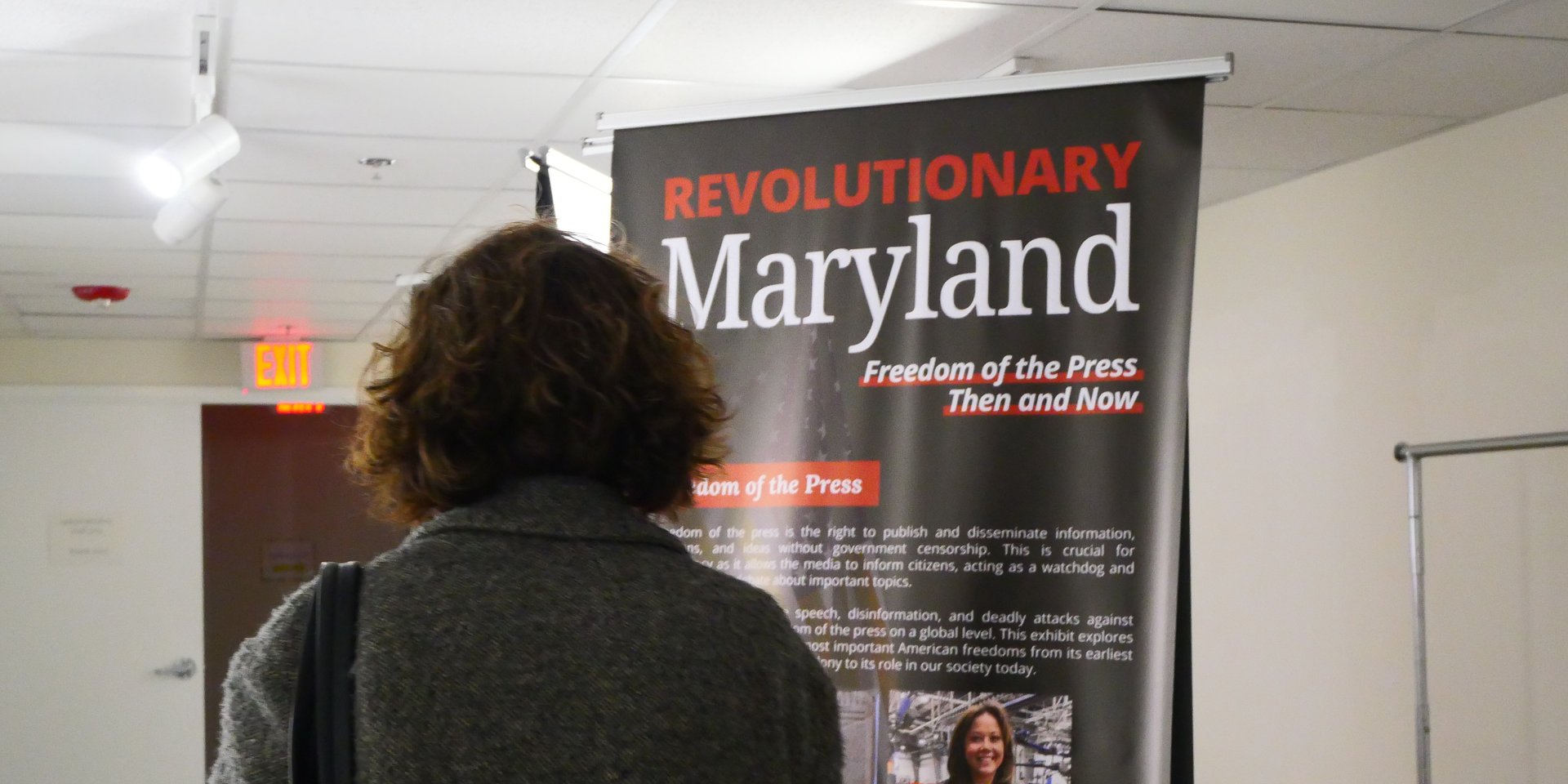
The Revolutionary Maryland: Freedom of the Press Then and Now traveling exhibition, which opened at the Arundel Center on Tuesday, January 13, and the Museum of Eastern Shore Culture on Saturday, January 17, explores the evolution of one of our most important American freedoms from its earliest incarnation in the Maryland Colony to its role in contemporary society. The opening of the exhibit in Annapolis is significant as the capital city was the site of the violent Capital Gazette mass shooting in 2018. Over the course of 2026, the exhibition will travel to eight locations across the state and will feature complementary humanities programs and educational initiatives about this essential American freedom. Major funding for the project was provided by the Maryland Two-Fifty Commission.
“We’re proud to bring Revolutionary Maryland: Freedom of the Press Then and Now across the state of Maryland throughout 2026, inviting local communities to reflect on the long history of freedom of the press in Maryland and to consider its urgent relevance today,” says Lindsey Baker, Chief Executive Officer of Maryland Humanities. “By bringing together history, archaeology, and journalism, this exhibition creates space for thoughtful dialogue about the role a free press plays in sustaining an informed, engaged, and resilient democracy.”
The multi-panel exhibit highlights archaeological investigations undertaken at the 18th century Jonas and Anne Catherine Green printshop, the importance of inclusive journalism outlets like Afro Charities, and the persistence of local new sources like those supported by the Tiny News Collective. Public programming in host communities will include companion exhibits, lecture panel presentations, and other opportunities to highlight local stories.
This exhibit is one element of a multi-pronged project designed to encourage all citizens to think critically about the role of a free press to self-government in democracy. Concurrent with the traveling exhibit will be the rehousing and conservation of 170 boxes of artifacts associated with Archaeology in Annapolis excavations at the Jonas Green House in the mid-1980s. This work will be overseen by the Maryland Archaeological Conservation Lab, where the collection will ultimately be stored. The Jonas Green artifacts have extraordinary research potential as excavations at this site produced the largest collection of printer’s type ever recovered archaeologically in the United States.
The project’s culminating event will be a “Community Conversation” taking place in November in Annapolis, Maryland. This free public event will feature a keynote speaker followed by a moderated discussion about how citizens can reclaim the media arena as a place for the open exchange of opinion, discussion, and deliberation. Time will be built into the program to allow for audience questions. In addition to the moderated discussion, the event will offer a more robust version of the traveling exhibit with additional information about the Jonas Green curation project, including the display of artifacts.
Learn more on Maryland Humanities' website. For more information, contact Robert Forloney, Program Officer, Partnerships, at Maryland Humanities at rforloney@mdhumanities.org or (410) 463-2293.
Revolutionary Maryland: Freedom of the Press Then and Now is a partnership between Maryland Humanities; the Maryland Historical Trust; Jefferson Patterson Park and Museum; Historic Annapolis, Inc.; Afro Charities; the Tiny News Collective; and local partners, Chesapeake Crossroads Heritage Area and Museum of Eastern Shore Culture. Major funding for the project was provided by the Maryland Two-Fifty Commission.
About Maryland Humanities
Maryland Humanities creates and supports bold experiences that explore and elevate our shared stories to connect people, enhance lives, and enrich communities. Maryland Humanities is generously supported by the National Endowment for the Humanities, the State of Maryland, the Citizens of Baltimore County, private foundations, corporations, small businesses, and individual donors. Connect with Maryland Humanities on Facebook, Instagram, Threads, LinkedIn, and YouTube.